![[PukiWiki]](image/pukiwiki.png "[PukiWiki]")
iPhoneのアプリケーション開発を行うための、ごくごく簡単なメモです。 iPhoneアプリを開発するための How2iPhoneProgramming をも参考にしてください。
xcodeで、Audio Toolbox フレームワークを設定しておく。
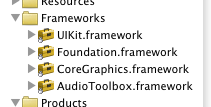
次に、以下のクラスを作っておく。
//
//  SoundPlayer.h
//
//  Created by SIIO Itiro on 11/04/17.
//  Copyright 2011 __MyCompanyName__. All rights reserved.
//

#import <Foundation/Foundation.h>
#import <AudioToolbox/AudioToolbox.h>

@interface SoundPlayer : NSObject {
	AudioQueueRef queueRef;
}


-(id)init;
-(void)start;
-(void)pause;
-(void)stop;

@end
//
//  SoundPlayer.m
//
//  Created by SIIO Itiro on 11/04/17.
//  Copyright 2011 __MyCompanyName__. All rights reserved.
//

#import "SoundPlayer.h"


#define SAMPLERATE 44100.0f
#define FL ((2.0f * 3.14159f) / SAMPLERATE)
#define FR ((2.0f * 3.14159f) / SAMPLERATE)
#define FRAMECOUNT 1024
#define NUM_BUFFERS 3


@implementation SoundPlayer

static void aqCallBack(void *in, AudioQueueRef q, AudioQueueBufferRef qb) {

	static int phaseL = 0;
	static int phaseR = 0;

	short *sinBuffer = (short *)qb->mAudioData;

    float sampleL = 0.0f;
    float sampleR = 0.0f;

	float amplitude = 1.0f, pitch=100.0f;

	qb->mAudioDataByteSize = 4 * FRAMECOUNT;
	// 1 frame per packet, two shorts per frame = 4 * frames
	for(int i = 0; i < ( FRAMECOUNT * 2 ) ; i+=2) {
		sampleL = (amplitude * sin(pitch * FL * (float)phaseL));
		sampleR = (amplitude * sin(pitch * FR * (float)phaseR));

		short sampleIL = (int)(sampleL * 32767.0f);
		short sampleIR = (int)(sampleR * 32767.0f);
		sinBuffer[i] = sampleIL;
		sinBuffer[i+1] = sampleIR;
		phaseL++;
		phaseR++;
	}//end for
	AudioQueueEnqueueBuffer(q, qb, 0, NULL);

}


-(id)init {
	AudioStreamBasicDescription dataFormat;
    AudioQueueBufferRef buffers[NUM_BUFFERS];

	self = [super init];

	dataFormat.mSampleRate = SAMPLERATE;
	dataFormat.mFormatID = kAudioFormatLinearPCM;
	dataFormat.mFormatFlags = kLinearPCMFormatFlagIsSignedInteger | kAudioFormatFlagIsPacked;
	dataFormat.mBytesPerPacket = 4;
	dataFormat.mFramesPerPacket = 1;
	dataFormat.mBytesPerFrame = 4;
	dataFormat.mChannelsPerFrame = 2;
	dataFormat.mBitsPerChannel = 16;

	AudioQueueNewOutput(&dataFormat, aqCallBack, self, NULL, kCFRunLoopCommonModes, 0, &queueRef); // CFRunLoopGetCurrent()

	for(int i = 0; i < NUM_BUFFERS; i++) {

		UInt32 err =
		AudioQueueAllocateBuffer(queueRef, FRAMECOUNT * dataFormat.mBytesPerFrame, &buffers[i]);
		if(err) {
			NSLog(@"err:%d\n");
		}//end if

		aqCallBack(self, queueRef, buffers[i]); //prime buffer
	}//end for
	AudioQueueSetParameter(queueRef, kAudioQueueParam_Volume, 1.0f);

	return self;

}


-(void)start {
	AudioQueueStart(queueRef, NULL);
}

-(void)pause{
	AudioQueuePause(queueRef);
}

-(void)stop {
	AudioQueueStop(queueRef, true);
}

-(void)dealloc {
	AudioQueueDispose(queueRef, true);
	[super dealloc];
}


@end
どこかで
SoundPlayer *sp1;
と定義しておいて、
sp1 = [[SoundPlayer alloc] init];
としてインスタンス化する。これに対して、
[sp1 start];
とすれば100kHzの正弦波が再生される。 一方、
[sp1 pause];
とすれば、再生が停止する。最後に、どこかで、
[sp1 dealloc];
として解放しておくことを忘れずに。


